Cottonwood
CSU Extension names it among soft-wooded trees that often break in storms. Near a house, big ones need rigging, which is why they sit at the top of the price range.

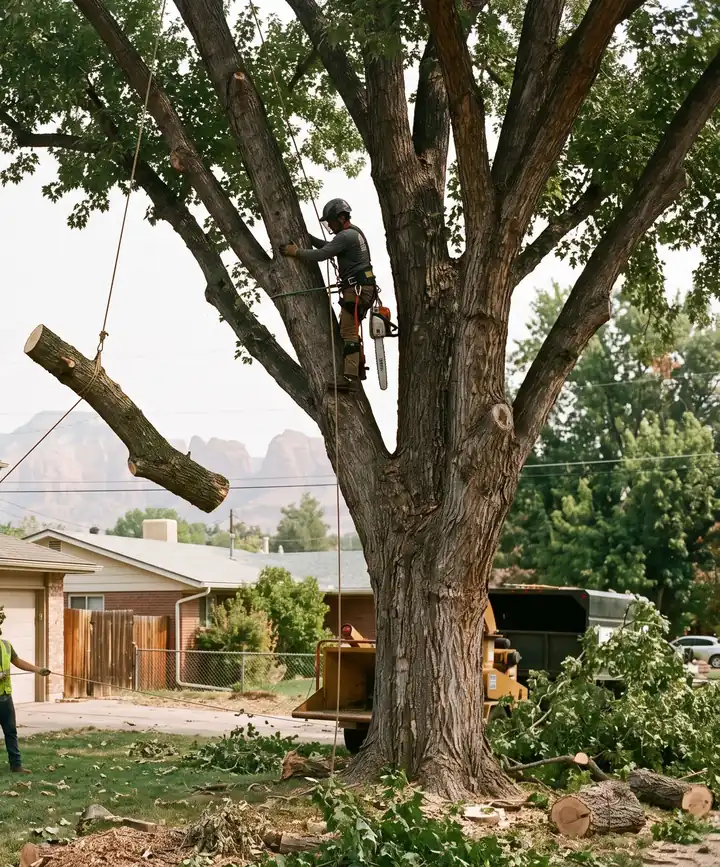
Tree removal in Grand Junction usually means a crew takes the tree down in sections, lowers the heavy pieces on ropes, and hauls the wood. With a GJ Tree Co quote, you see the price in writing before a saw starts.
Get a free quote Call 970-902-1212Keep it or lose it
Remove a tree when it is dead, hollow, splitting at a major union, heaving at the roots, or leaning toward something it could hit. If the tree is healthy and only one limb is the worry, ask about pruning first. Removal is the one tree job you cannot undo.
The job, in order
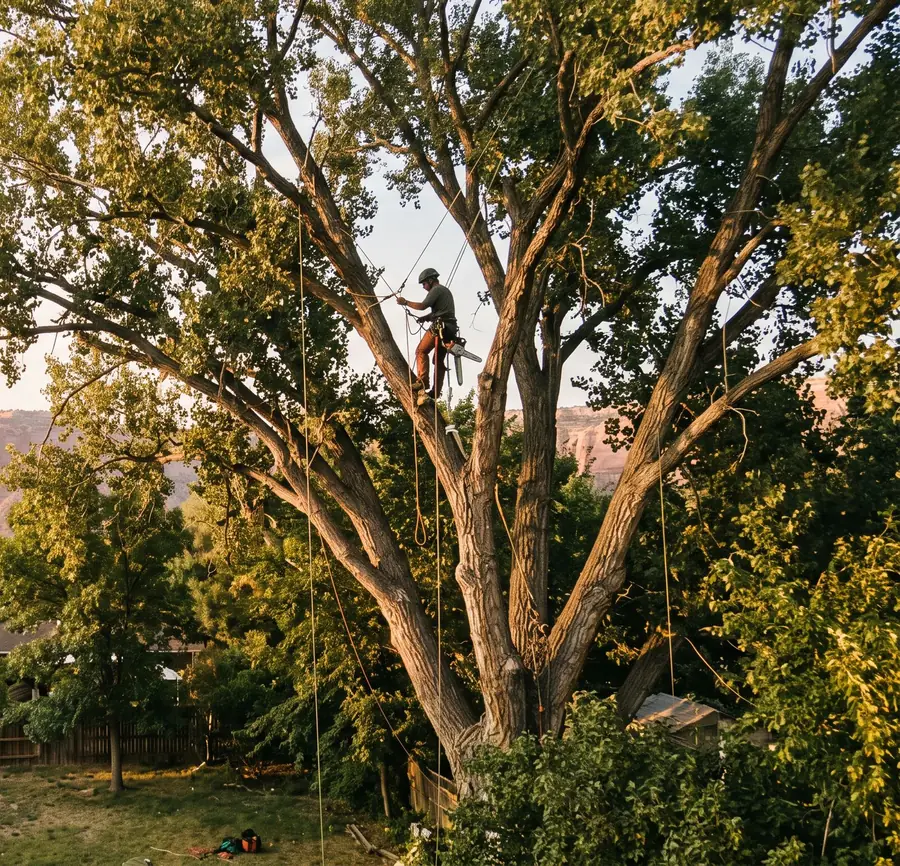
Big trees near houses rarely fall in one piece. The crew plans a drop zone, climbs or uses a lift, and rigs each heavy section down. Open-yard trees may be felled whole. The sequence below is what to expect, and what to ask about if a quote skips a step.
The crew checks the drop zone, roofs, fences, utility lines and how a truck reaches the tree. Expect questions about gates, sprinkler lines and where the wood should go.
The quote names what is included: takedown, hauling, stump and cleanup. If something is left out, ask now, not at the end.
Cars move, gates open and pets stay in. Anything near a power line waits for the utility. Tree crews do not touch energized lines.
Limbs first, then the trunk from the top. Heavy pieces are lowered on ropes near roofs rather than dropped.
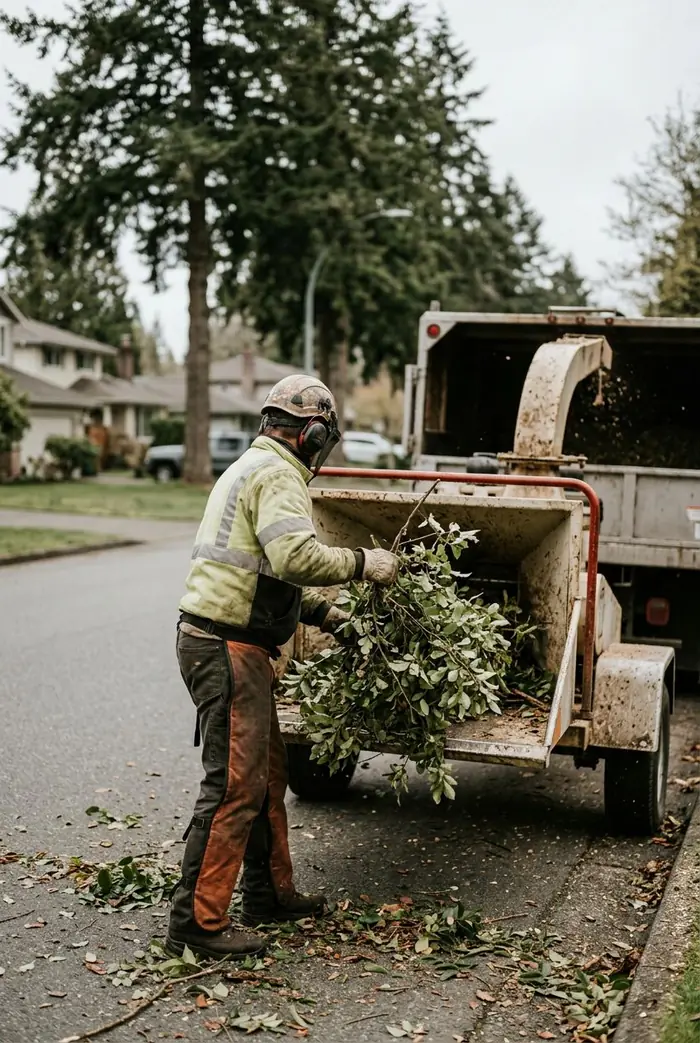
Brush goes through the chipper, wood is hauled or stacked as agreed, and the stump is ground if you chose it. See stump grinding.
Permits and paperwork
Who owns the ground decides the paperwork. Inside Grand Junction, any tree on City property needs a public tree maintenance permit before removal, usually in the strip between sidewalk and street. Private trees generally do not, but the company you hire still needs a City license to work within city limits.
Local trees
Four trees account for a lot of Grand Valley removal talk. Cottonwood and Siberian elm grow fast and break in storms, Russian olive is a state-listed noxious weed that resprouts, and ash faces emerald ash borer. None of the four is permitted as a new Grand Junction street tree.
CSU Extension names it among soft-wooded trees that often break in storms. Near a house, big ones need rigging, which is why they sit at the top of the price range.
CSU Extension calls its branches brittle and prone to breakage. It is often the tree dropping limbs over alleys and fences.
A List B noxious weed in Colorado. Cut trees can resprout, so ask how the stump will be handled before you agree on a price.
Emerald ash borer was confirmed in Carbondale in 2023. A healthy ash may be worth treating, so get a thinning crown checked before paying to remove it.
Straight talk on price
Typical Grand Valley ranges run about $210 to $400 for a small tree in an open yard and $1,170 to $1,910 for one over 80 feet. Being close to a house or power lines adds more. Height, lean, what sits underneath and truck access move the price most. The crew gives the exact figure.
Replanting after? The Forestry Board publishes a Grand Valley All-Star Tree List.
Get a removal quoteOpen yard, truck at the tree, from published cost guides adjusted by the Grand Junction price index. Close to a house or lines costs more. See the sources and the math. You still get an exact figure in writing.
Short answers
What Grand Junction homeowners ask before they let a saw near the yard.
Plan on about $210 to $1,910 for a tree in an open yard. That is the typical Grand Valley range, from published cost guides adjusted by the local price index. A tree close to a house or power lines costs more. Height, lean and truck access move the price, and the crew puts the exact figure in writing.
Yes, if the tree is on City property, typically the right-of-way between the sidewalk and the street. The City requires a public tree maintenance permit before pruning, removal or treatment, and asks you to request it before hiring a provider. For other trees, ask what applies at your address and check any HOA covenants.
Not always, so ask before you agree. A removal price may stop at a flush-cut stump, with grinding, wood hauling and raking listed separately. Get each one spelled out in the written quote, including who keeps the firewood rounds, so the yard ends up the way you pictured it.
Not until the utility clears it. Call Xcel Energy or Grand Valley Power, whichever is on your bill, and treat the line as live. Stay clear of the tree and anything touching it. If a line is down or anyone is hurt, call 911 first. The tree crew finishes once the utility says it is safe.
Look at the trunk, the unions and the lean. Dead crowns, hollow trunks, splitting unions and a new lean toward a house point to removal. A thinning crown alone may not. If the call is close, ask an ISA Certified Arborist for an opinion before you pay to take down a tree that could be pruned instead.
Send the details
Tell us which tree and what worries you. We follow up with next steps and a written price.
If a tree is on a power line or anyone is hurt, call 911 or your electric utility first.
Deadwood, heavy limbs and clearance.
Ground below grade, ready to replant.
Who to call first, and what comes next.
Yellow leaves, dead limbs, beetles and cankers.
Support for a weak fork or a heavy limb.
Lots, brush, Russian olive and tamarisk.
Thinning and cleanup around the home.
Guides and tools: Grand Valley tree guide, Tree permit and HOA checker, Tree removal cost estimator, Storm alerts and damage help.
Get a free quote from any Grand Valley community on this list.