Train young trees
Early pruning improves form, so fewer weak unions form later.

Storm damage in Grand Junction, CO
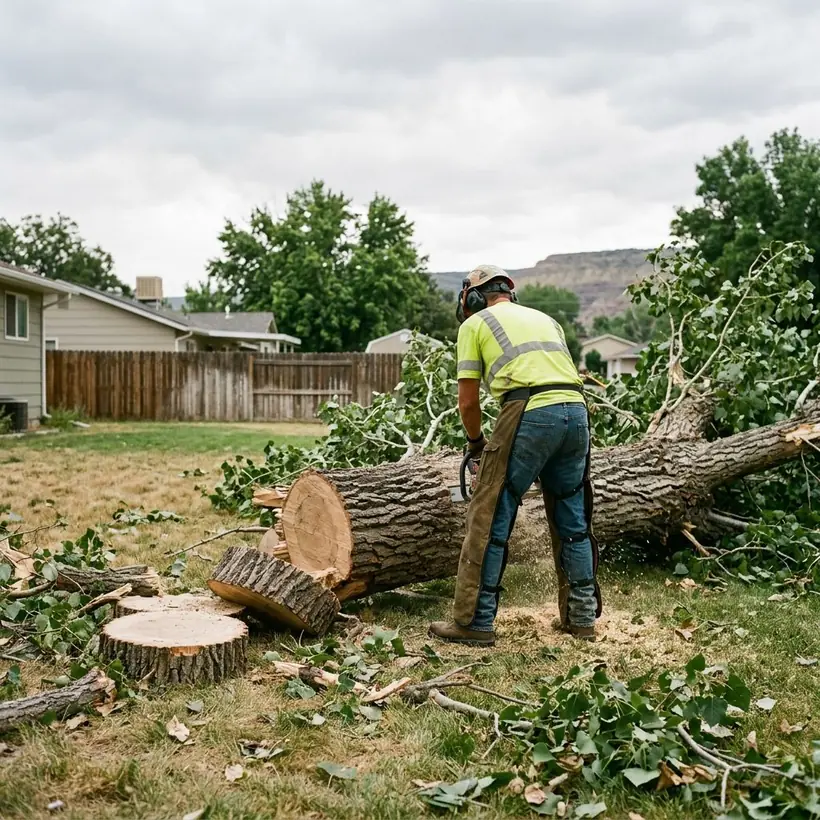
After a wind or storm in Grand Junction, stay clear of hanging limbs and anything near a line, and call 911 or your utility for downed wires. Then check whether the tree can be saved. Colorado foresters say a healthy tree with its leader and half its crown has a good chance of recovery.
Live alerts
This panel reads the National Weather Service directly when the page opens. If an alert for wind, severe storms or a winter storm is active, a banner also appears across this site. When nothing is active or the service cannot be reached, the advice below still applies.
Live alerts load with JavaScript. If they do not appear, check the National Weather Service Grand Junction page for wind and storm warnings.
In order
From the Colorado State Forest Service and the International Society of Arboriculture. A tree already on a house or a line is an emergency, so go straight to who to call first.
Before approaching, look for downed lines and broken limbs still hanging overhead. ISA warns that limbs under tension can react unexpectedly when cut.
Call 911 for a down or sparking line. Then call Xcel Energy at 800-895-4999 or Grand Valley Power at 970-242-0040.
Trees between the street and sidewalk may be the city's. Grand Junction forbids pruning or removing public trees without contacting Forestry. Our permit checker covers other towns.
Use the checks below. Photograph the damage first if you may claim on insurance.
CSFS says to prune broken branches at the branch collar and call an insured, certified arborist for chainsaw work overhead, ladders, big limbs or whole trees.
Save it or remove it
Colorado State Forest Service guidance is simple: a tree that is healthy overall and keeps its leader, most major limbs and at least half its crown has a good chance of a complete recovery. Do not over-prune for looks, since most trees quickly grow foliage that hides bare areas.
Cleanup
Burning storm wood is rarely an option in town. Mesa County Public Health limits residential burns to lots of one acre or more, during open burn seasons, with a permit, and only trimmings under one inch thick. Most storm cleanup means chipping and hauling instead.
| Where | Spring season | Fall season |
|---|---|---|
| Mesa County | March 1 through May 31 | September 1 through October 31 |
| City of Grand Junction | March 1 through April 30 | September 1 through September 30 |
Check the county page or call 970-248-6900 before burning, because no burn advisories and fire restrictions override permits. Do not move elm wood with bark inside Grand Junction except for approved disposal, under Chapter 8.32.
Before the next one
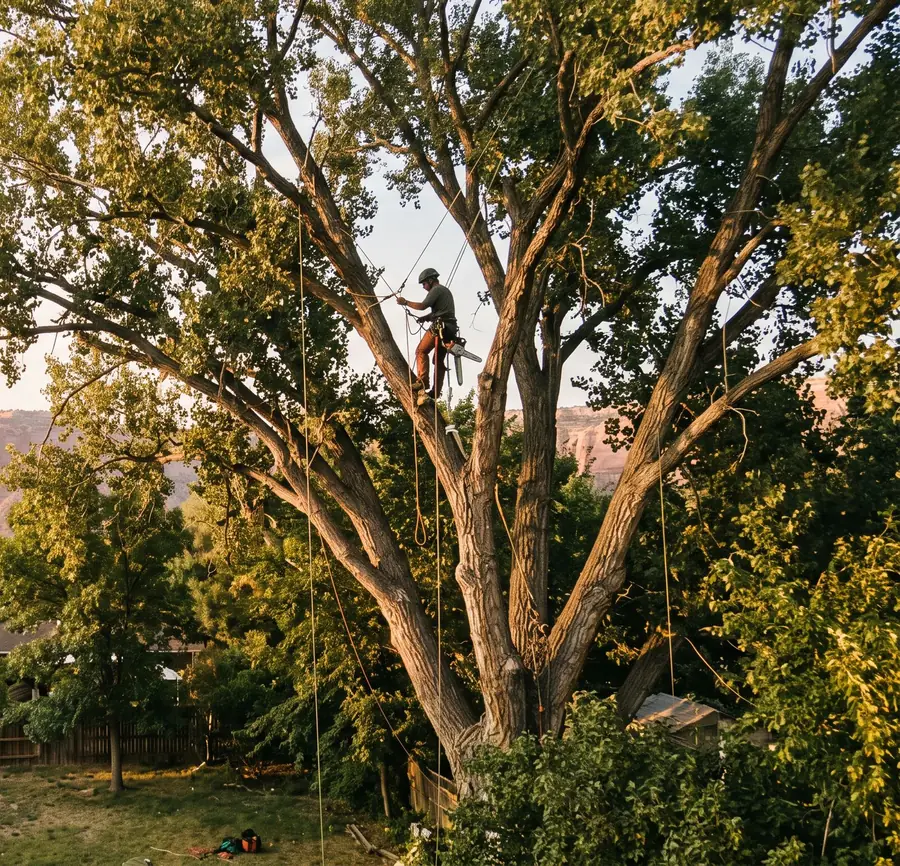
The International Society of Arboriculture says no one can prevent all storm damage, but a certified arborist can spot weak points and prepare a tree for rough weather. Here is what that usually means.
Early pruning improves form, so fewer weak unions form later.
Look for weak branches, trunk and root problems, then decide how to manage them.
Dead and defective branches are the first to come down, so take them off first.
The panel on this page reads active National Weather Service alerts for the Grand Valley when it opens. If it cannot load, check the NWS Grand Junction page. We show wind, severe storm and winter storm alerts, and the site banner only appears for those. Always follow official instructions over anything here.
Stay clear of hanging limbs and lines, and report any downed wire to 911 and your utility. Then find out who owns the tree, and assess the damage before cutting. Limbs under tension can spring when cut, and limbs resting on other trees can still move, so leave those for a crew.
Often yes, if it was healthy, still has its leader and keeps about half its crown. The Colorado State Forest Service says the chance of a full recovery is good in that case. Prune broken branches back to the branch collar and avoid over-pruning. Trees missing most major limbs deserve an arborist's look.
Usually not, because residential burning needs a permit and a lot of one acre or more. Mesa County Public Health limits residential burns to dry trimmings under one inch thick during open burn seasons, and the city season is shorter than the county season. Most storm wood needs chipping or hauling.
It may belong to the city, so contact them before anyone touches it. In Grand Junction, trees between the sidewalk and the street are generally public, and the City provides their maintenance. Call Forestry at 970-254-3861. Elsewhere, check our permit checker for your town.
Sources
We read each page below on the date shown, and alerts come live from the National Weather Service. The Colorado State Forest Service tips are adapted from International Society of Arboriculture advice, and they date from 2016, so they are general guidance rather than new research.
Live alerts for the Grand Valley zone and Mesa County.
AccessedThe forecast office for the valley, and the fallback when live alerts cannot load.
AccessedHazard checks, the recovery test, pruning advice and when to hire out.
AccessedHow storms damage trees, tension hazards and preventive care.
AccessedReport broken branches on lines, and the 800-895-4999 number.
AccessedThe 970-242-0040 outage number.
AccessedBurn seasons, the one acre rule, what can burn and the 970-248-6900 number.
AccessedThe rule against damaging public trees, and how to tell public from private.
Accessed
Send the details
Tell us what came down and what it is near, with photos if it is safe to take them. We follow up with next steps and a written price.
If a tree is on a power line or anyone is hurt, call 911 or your electric utility first.
Dead, leaning or too close to the house.
Deadwood, heavy limbs and clearance.
Ground below grade, ready to replant.
Yellow leaves, dead limbs, beetles and cankers.
Support for a weak fork or a heavy limb.
Lots, brush, Russian olive and tamarisk.
Thinning and cleanup around the home.
Guides and tools: Grand Valley tree guide, Tree permit and HOA checker, Tree removal cost estimator, Storm alerts and damage help.